Quick answer
Black Obsidian is Mohs 5-5.5, which makes it a careful-wear stone - fine on a wrist, easy to scratch. It copes with a quick rinse in lukewarm water and mild soap. What is sold in its place: black glass (chemically identical in practice).
What Black Obsidian is
Black Obsidian belongs to the Volcanic glass family. You will normally meet it as pendants, bracelets, tumbled stones and spheres. In the trade its color is described as black, rainbow and snowflake.
Its published hardness is Mohs 5-5.5. That puts it in the careful-wear group: fine on a wrist or at the neck, but it picks up scratches from harder neighbours, so keep it away from quartz in a jewelry box. It is not something to put in an everyday ring.
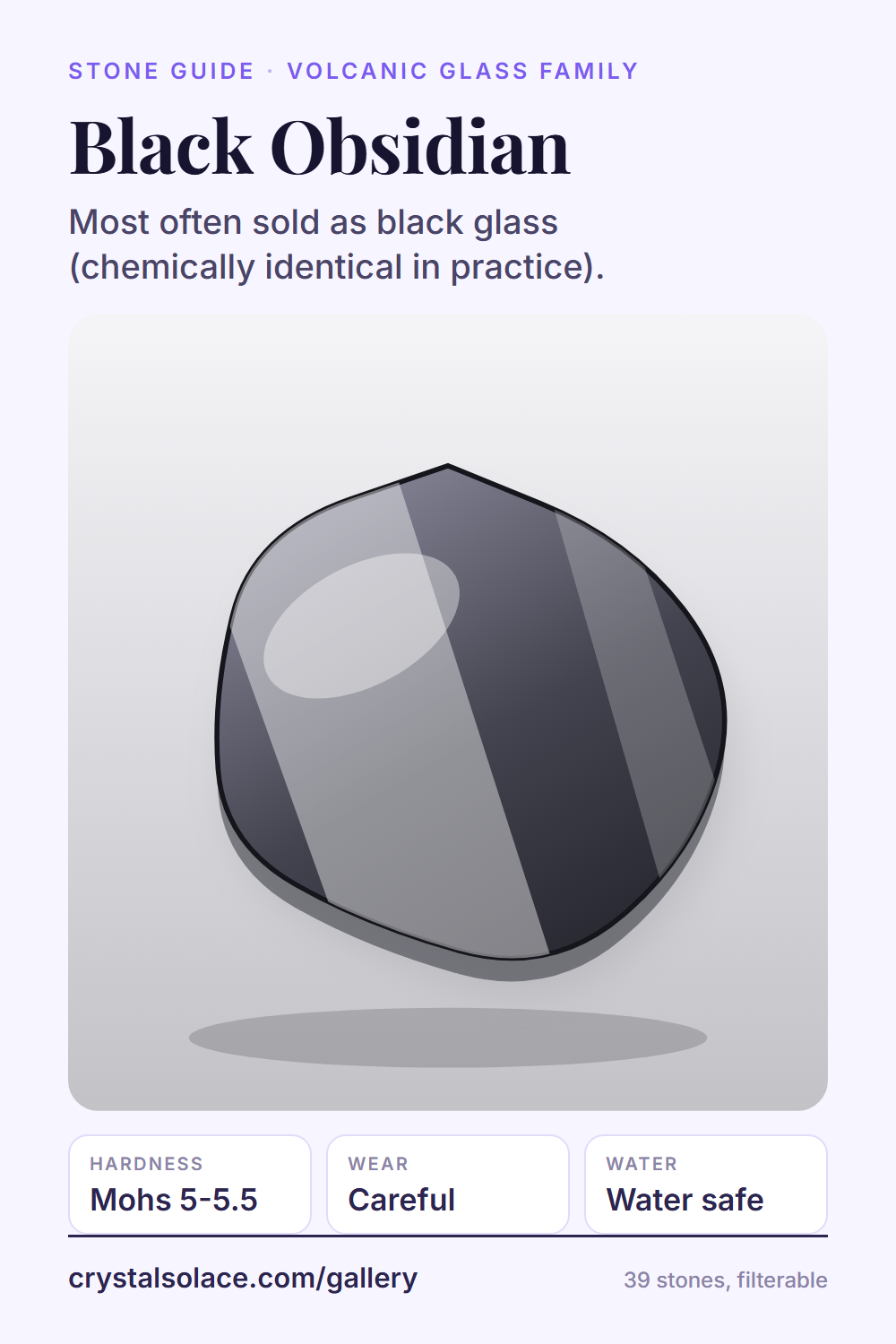
The record for Black Obsidian
| Field | Value |
|---|---|
| Hardness | Mohs 5-5.5 |
| Everyday wear | Careful wear |
| Ring-ready | Not as an everyday ring |
| Water | Water safe |
| Crystal water | Sealed container only - the stone must not sit in the water. |
| Toxicity | No known toxicity |
| Common forms | pendants, bracelets, tumbled stones, spheres |
| Colors in trade | black, rainbow, snowflake |
| Routine treatments | none meaningful |
Short contact with lukewarm water and mild soap does no harm. Sealed container only - the stone must not sit in the water. No hazard is expected from ordinary hand contact.
These values are the same ones the fake diagnostic, the pairing checker and the gallery grid read. They are species-level figures: a specific piece can behave differently if it is treated, fractured or cut unusually thin.
What is sold in place of Black Obsidian
- black glass (chemically identical in practice)
1 substitution is recorded against this stone in the data behind this site, and it comes down to a cheaper material cut to the same shape.
That division matters more than the list does. Each of those four kinds fails a different test: a substitute material is usually caught by weight or by a scratch, a color treatment by looking for dye in a chip or a fracture, a lab-grown stone by its inclusions and sometimes only in a laboratory - and a real stone sold under a better name passes every physical test there is, because there is nothing physically wrong with it. Two pieces can be the same mineral and one of them is still not what you paid for.
Two guides go further into that: how to tell real stones from fakes covers what you can check at home, and the fakes atlas maps the whole pattern across 39 species. To work through one suspect piece, use the fake diagnostic.
What Black Obsidian costs
| Form | Typical retail band |
|---|---|
| bracelets | $10 - $25 |
| tumbled stones | $2 - $6 |
| pendants | $12 - $35 |
These are bands for ordinary retail pieces, not for collector material. The cheapest form is usually tumbled or beads and the most expensive is usually a ring, which is also the form where a bad stone costs you the most. A price well below the bottom of these bands is the single most useful warning sign there is - it is not proof of anything on its own, but it moves the question from "is this a good piece" to "what exactly is this".
To see where this sits against a budget, the finder takes an amount and a list of forms and returns what fits. For the reasoning behind these bands, see the price guide.
If you are buying Black Obsidian
- Ask what the stone is and what has been done to it. In most markets treatment disclosure is expected; a seller who will not answer is telling you something.
- For anything worn daily, black obsidian is better in a pendant or an earring than in a ring.
- No routine treatment is recorded for this species, so a treated piece is a reason to ask more questions.
- It copes with a quick rinse in lukewarm water and mild soap. Dry it afterwards.
The four things that decide whether any stone works for you are hardness, how it behaves in daily wear, what it does around water, and what is most often sold in its place. On this stone they read: Mohs 5-5.5, careful wear, water safe, and 1 recorded substitutions.


Where Black Obsidian fits on this site
This record sits at the intersection of three other pages: the gallery puts all 39 species in one filterable grid, the fake diagnostic walks through one suspect piece at a time, and the finder turns a budget into a shortlist. For the long version of this stone in particular, read How Much Do Crystals Actually Cost? An Honest Price Guide. The hardness, wear and water figures quoted throughout come from one shared data file, so they agree everywhere on the site.
Sources
- Mohs hardness values and species data cross-checked against Mindat, the mineral database of the Hudson Institute of Mineralogy.
- Treatment terminology follows the Gemological Institute of America gem-treatment guidance.
- Identification limits - hardness testing, specific gravity, refractive index - as described in the GIA Gem Encyclopedia.
Disclaimer
This is reference information for buying, wearing and cleaning stones. It is not a laboratory identification, and a given piece can behave differently from its species if it is treated, fractured or unusually thin. Nothing on this page is medical advice, and none of the ratings describe a health effect of any kind. For anything you intend to swallow, put on broken skin or steep in drinking water, treat an in-person assessment by a jeweler or mineralogist as the only reliable answer.