Quick answer
Citrine is Mohs 7, which puts it in the everyday-wear group. It copes with a quick rinse in lukewarm water and mild soap. What is sold in its place: heated amethyst sold as natural, lemon quartz and glass, plus 1 more recorded in the list below.
What Citrine is
Citrine belongs to the Quartz family. You will normally meet it as rings, pendants, bracelets, tumbled stones and clusters. In the trade its color is described as yellow, golden, orange and amber.
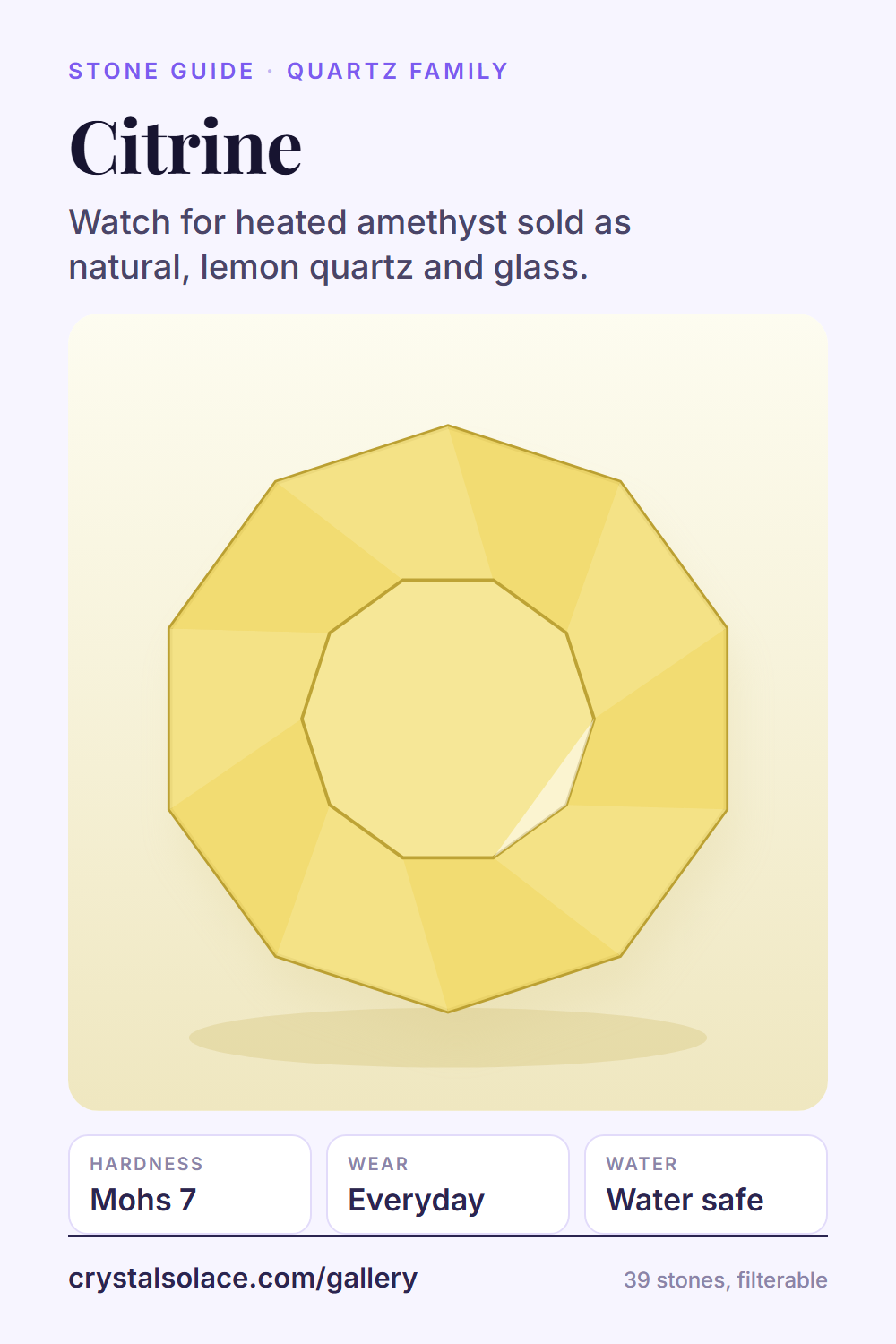
Its published hardness is Mohs 7. That puts it in the everyday-wear group: it can share a hand or a pocket with keys, coins and a phone, and a knock is not news. It is sensible as an everyday ring.
The record for Citrine
| Field | Value |
|---|---|
| Hardness | Mohs 7 |
| Everyday wear | Everyday wear |
| Ring-ready | Yes - sensible as an everyday ring |
| Water | Water safe |
| Crystal water | Sealed container only - the stone must not sit in the water. |
| Toxicity | No known toxicity |
| Common forms | rings, pendants, bracelets, tumbled stones, clusters |
| Colors in trade | yellow, golden, orange, amber |
| Routine treatments | heating (amethyst, very common), irradiation (rare) |
Short contact with lukewarm water and mild soap does no harm. Sealed container only - the stone must not sit in the water. No hazard is expected from ordinary hand contact.
These values are the same ones the fake diagnostic, the pairing checker and the gallery grid read. They are species-level figures: a specific piece can behave differently if it is treated, fractured or cut unusually thin.
What is sold in place of Citrine
- heated amethyst sold as natural
- lemon quartz
- glass
- dyed quartz
4 substitutions are recorded against this stone in the data behind this site, and they divide into a cheaper material cut to the same shape, the same stone in a color it does not occur in and a genuinely different stone carrying a more valuable name.
That division matters more than the list does. Each of those four kinds fails a different test: a substitute material is usually caught by weight or by a scratch, a color treatment by looking for dye in a chip or a fracture, a lab-grown stone by its inclusions and sometimes only in a laboratory - and a real stone sold under a better name passes every physical test there is, because there is nothing physically wrong with it. Two pieces can be the same mineral and one of them is still not what you paid for.
Two guides go further into that: how to tell real stones from fakes covers what you can check at home, and the fakes atlas maps the whole pattern across 39 species. To work through one suspect piece, use the fake diagnostic.
What Citrine costs
| Form | Typical retail band |
|---|---|
| bracelets | $18 - $55 |
| tumbled stones | $3 - $12 |
| pendants | $16 - $60 |
These are bands for ordinary retail pieces, not for collector material. The cheapest form is usually tumbled or beads and the most expensive is usually a ring, which is also the form where a bad stone costs you the most. A price well below the bottom of these bands is the single most useful warning sign there is - it is not proof of anything on its own, but it moves the question from "is this a good piece" to "what exactly is this".
To see where this sits against a budget, the finder takes an amount and a list of forms and returns what fits. For the reasoning behind these bands, see the price guide.
If you are buying Citrine
- Ask what the stone is and what has been done to it. In most markets treatment disclosure is expected; a seller who will not answer is telling you something.
- For a ring, this is a stone that can take everyday wear - the setting is then the thing most likely to fail, not the stone.
- Routine treatments for this species include heating (amethyst, very common) and irradiation (rare) - most are normal and disclosable, and none of them make the stone a different stone.
- It copes with a quick rinse in lukewarm water and mild soap. Dry it afterwards.
The four things that decide whether any stone works for you are hardness, how it behaves in daily wear, what it does around water, and what is most often sold in its place. On this stone they read: Mohs 7, everyday wear, water safe, and 4 recorded substitutions.


Where Citrine fits on this site
This record sits at the intersection of three other pages: the gallery puts all 39 species in one filterable grid, the fake diagnostic walks through one suspect piece at a time, and the finder turns a budget into a shortlist. For the long version of this stone in particular, read Citrine Buying Guide: Natural or Heated, and What to Pay. The hardness, wear and water figures quoted throughout come from one shared data file, so they agree everywhere on the site.
Sources
- Mohs hardness values and species data cross-checked against Mindat, the mineral database of the Hudson Institute of Mineralogy.
- Treatment terminology follows the Gemological Institute of America gem-treatment guidance.
- Identification limits - hardness testing, specific gravity, refractive index - as described in the GIA Gem Encyclopedia.
Disclaimer
This is reference information for buying, wearing and cleaning stones. It is not a laboratory identification, and a given piece can behave differently from its species if it is treated, fractured or unusually thin. Nothing on this page is medical advice, and none of the ratings describe a health effect of any kind. For anything you intend to swallow, put on broken skin or steep in drinking water, treat an in-person assessment by a jeweler or mineralogist as the only reliable answer.